 English
 שפה עברית
 беларускі
 Punjabi
 Español
 Português
 русский
 Français
 日本語
日本語 Deutsch
 Italiano
 Nederlands
 한국어
한국어 Malay
Malay हिन्दी
 Türkçe
 العربية
 Indonesia
 Română
 Srpski језик
Weather Station Clock: Putting the Weather Forecast "On Your Wall"
Waking up and no longer agonizing over "do I need a jacket today?" — weather station clocks are making this daily decision simpler. These devices combine precise timekeeping with real-time weather monitoring, gradually becoming a practical addition to many homes and office desks.
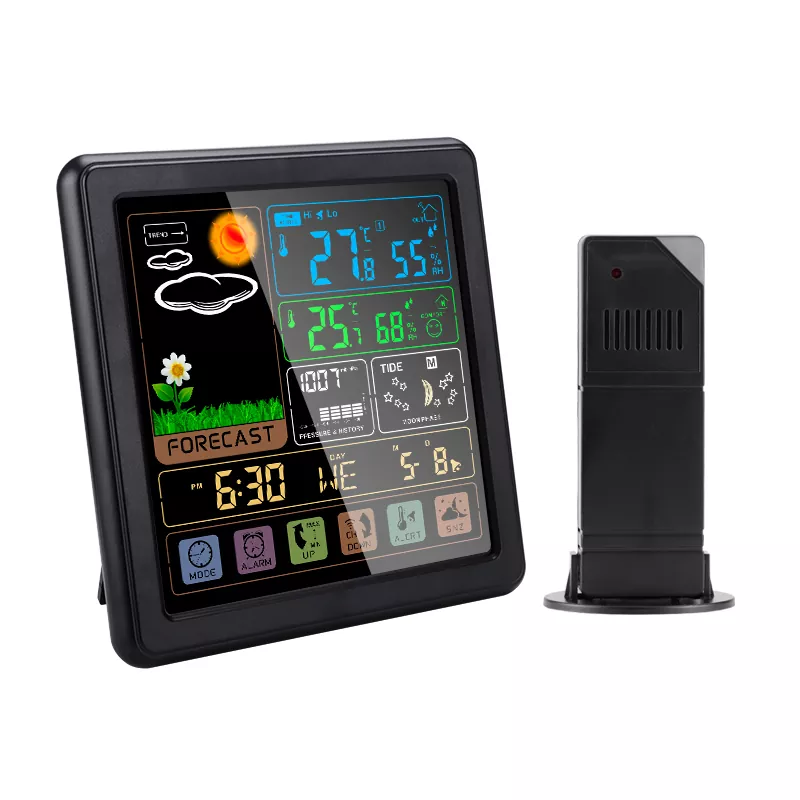
What Is It?
A weather station clock is essentially a multifunctional display that integrates meteorological sensors. It typically consists of an indoor main unit and an outdoor sensor module. The sensors collect outdoor data, while the main unit displays indoor/outdoor temperature, humidity, weather trends, and other information — all while functioning as a clock, calendar, and alarm.
The core problem it solves is "information fragmentation": You don't need to pick up your phone to check the weather, nor walk to the window to gauge the temperature. One glance at the screen on your desk tells you whether it's cold outside or if you need an umbrella.
How to Choose Among Different Tiers?
Current weather station clock products can be roughly divided into several levels:
Basic Practical Models (approx. $15–$45 USD): Focus primarily on clock and temperature/humidity display. These typically come with a wireless outdoor sensor, show indoor/outdoor temperature and humidity, and predict weather trends for the next 12–24 hours (sunny, cloudy, rainy, etc.) based on barometric pressure changes. Some models also support radio-controlled automatic time calibration, syncing to standard time via radio signals without manual adjustment. Users report these are "simple to set up, information at a glance" — great for kitchens or nightstands.
Advanced Multifunctional Models (approx. $45–$115 USD): Add more specialized monitoring capabilities. Beyond basic functions, these measure wind speed, wind direction, rainfall, UV intensity, and even light levels. Some support Wi-Fi connectivity, allowing remote data viewing via mobile apps or uploading to weather communities like Weather Underground. Users mention these "look techy on the desk" and work well as bedroom clocks, with the auto time calibration saving the hassle of adjusting for Daylight Saving Time.
Design-Focused or Professional-Grade ($115+ USD): Split into two directions. One emphasizes design — like the Wood Station Clock, which uses recycled wood for its casing and allows the display light to shine through the wood, starting at around $175. The other direction offers more professional weather stations with richer data logging capabilities and support for multiple external sensors, catering to weather enthusiasts.
Real User Feedback: What Works and What Doesn't
Looking at extensive user reviews, satisfaction with weather station clocks is generally high, but some recurring issues exist.
Well-Liked Features:
-
Large, legible displays: 7.5-inch screens mean "no squinting," with all data clearly visible
-
Auto time calibration: Radio-controlled or Wi-Fi syncing is very popular — "no more manual DST adjustments"
-
Practical and engaging: "Watching wind speed has become a hobby," especially for those in windy areas who enjoy real-time outdoor condition updates
Common Complaints and Issues:
-
Weather forecasts aren't very accurate: Multiple users report trend predictions based on barometric pressure are often wrong — "shows rain on sunny days, sunny on rainy days." This is actually a common limitation: these devices only make predictions based on pressure trend changes, far less accurate than professional weather apps.
-
Outdoor sensors are prone to problems: Some users report outdoor sensors fail in harsh weather or display abnormally high temperatures (e.g., due to direct sunlight exposure). Solar-powered models in particular "run out of power on cloudy days."
-
Clock accuracy issues: Some users report serious problems like "the clock loses several hours every day," requiring replacement units. When purchasing, pay attention to user feedback on timekeeping accuracy.
Buying Advice
-
Clarify your needs first: If you only need a general sense of temperature and time, a basic model is sufficient. If you want to track wind speed, rainfall, or need network connectivity, consider advanced models.
-
Pay attention to time calibration method: Radio-controlled or Wi-Fi time syncing is highly practical, saving you the trouble of manual adjustments.
-
Consider installation and placement: Outdoor sensors need to be installed away from direct sunlight and rain exposure to ensure data accuracy. Also, pay attention to the display's viewing angle — some models "must be viewed straight-on to be clear."
-
Don't overestimate the weather forecasting function: These devices' meteorological predictions are more of a "reference" than a guarantee. It's best to check your phone's weather app as well before heading out.
A weather station clock isn't an absolute necessity, but for those who like having weather conditions at a glance, it does offer some real convenience — one look before you step out, and you'll have a pretty good idea of what to expect.
Previous:No News
Send Inquiry



X
We use cookies to offer you a better browsing experience, analyze site traffic and personalize content. By using this site, you agree to our use of cookies.
Privacy Policy